


News & events
From farms to fuel: turning cow burps into clean energy
30 March, 2026
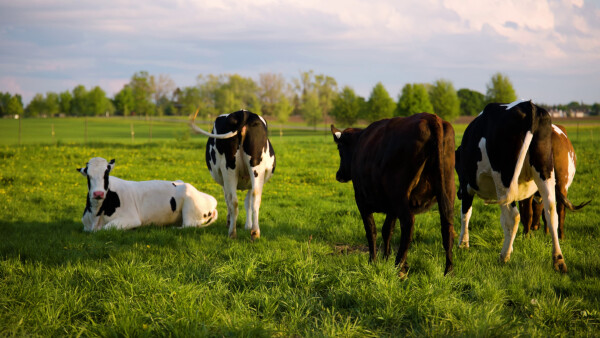
Aotearoa New Zealand’s agricultural sector faces a climate dilemma as herds of livestock emit methane, a greenhouse gas 28 times more potent than carbon dioxide.
The government in September 2025 scaled back its 2050 methane reduction emissions targets, but at the same time said it would commit $400 million to developing methane-cutting technology. This has added impetus to the work of our researchers who are tackling the methane issue from both ends — capturing the potent gas at the source and converting it into valuable products for the future.
MacDiarmid Institute Principal Investigator and Te Herenga Waka Victoria University of Wellington (VUW) Senior Lecturer Dr Luke Liu is tackling the tricky issue of capturing methane from farms, where it is diffuse and mixed with other gases.
“It’s not like going to a gas plant and trying to extract the methane,” he says. “When you’ve got lots of livestock all over a farm, that becomes a big challenge.”
Fundamentally, it is a materials performance and design problem
Dr Luke Liu Principal Investigator
Methane, MOFs and milking sheds
To address this, Luke and his colleagues are pioneering advanced porous materials called metal-organic frameworks (MOFs) that selectively trap methane from the low concentrations found in farm environments like milking sheds, barns and cattle feedlots.
“Fundamentally, it is a materials performance and design problem because there are so many MOFs out there, but none that can capture methane in the way we need for our agricultural emission concentrations,” Luke says.
Blending computer simulations, machine learning and experimental chemistry, the MacDiarmid Institute team can rapidly identify and test new MOF materials with the aim of turning dairy shed ventilation systems into methane scrubbers. While cows belch significant amounts of methane as they graze on pasture in paddocks, Luke estimates that a significant amount of methane can be captured when they are brought in for milking, or while housed in shelters or covered feedlots.
Finding the right formulation of a catalyst that is stable and has good enough longevity for methane is the technical challenge
Professor Alex Yip Associate Investigator
Turning methane into useful byproducts
Once methane is captured, what next? That’s where the work of Professor Alex Yip, MacDiarmid Institute Associate Investigator and Principal Investigator of the Laboratory for Energy and Environmental Catalysis at Te Whare Wānanga o Waitaha University of Canterbury (UC), kicks in.
“If you can give me methane, I can convert it to something else that’s useful. But that’s a big if,” says Alex, who specialises in catalysis, the process of speeding up the rate of a chemical reaction by using a catalyst, a material that drives the reactions but, crucially, isn’t itself consumed in the process.
“In this context, we’d aim to turn the methane, our feedstock material, into methanol, a liquid fuel that is transportable,” says Alex.
Methanol is desirable because it easily stores the carbon from methane in a stable and portable form — a kind of ’carbon immobilisation’. The process involves a couple of key steps: the first is steam reforming, where methane reacts to produce a blend of gases, including hydrogen. The second step is catalysis to transform those gases into methanol. Alex’s team is also experimenting with dry reforming, where they react methane with CO2, tackling two climate problems at once.
Alex’s laboratory focus is on designing and optimising these catalysts so that the conversion is efficient and robust.
Catalysts that last for years
“Finding the right formulation of a catalyst that is stable and has good enough longevity for methane is the technical challenge,” Alex points out.
The goal is for catalysts to remain active for years in industrial settings. Recent advances have seen lab catalysts perform for hundreds of hours, equating to around two years of industrial use, inching closer to the durability required for commercial uptake.
Neither researcher underestimates the logistical challenges of deploying catalyst technology on farms. Can’t devices be attached to cows, a gas-capturing version of the Halter collars used by farmers to herd their cows remotely?
Alex notes that wearable methane-capturing devices face practical hurdles, including animal welfare and product quality.
“It’s more than just building a device to put a tube in a cow,” says Yip. “There is animal behaviour associated with this, which we haven’t had to think about before.”
Still, one Aotearoa start-up, 28toZero, is developing just such a wearable device based on technology licensed from Lincoln Agritech. Pioneering MacDiarmid Institute work in catalyst design could underpin the innovation that the Government’s funding is designed to stimulate.
It wasn't a planned chemical discovery. It was a materials physics discovery that unlocked a pathway to pursue.
Professor Franck Natali Principal Investigator
Antiquated and energy-hungry
Meanwhile, MacDiarmid Institute Principal Investigator, VUW Professor Franck Natali, is tackling another greenhouse gas contributor that goes hand in hand with farming — ammonia, which is a key component in the production of nitrogen fertiliser.
“The problem with ammonia is that the current process itself, the Haber-Bosch method, is antiquated, energy-hungry and dirtily reliant on fossil fuels,” explains Franck, a physicist and materials scientist.
“I was inspired by the opportunity to apply advanced materials concepts to try and decarbonise this process.”
The project’s genesis lies in a serendipitous discovery. Franck’s team was studying how to make new semiconductor materials when it noted that one of the compounds being used was unexpectedly reacting with nitrogen, under low-pressure conditions, and virtually at room temperature.
“This suggested that our materials could help reduce the massive energy input necessary to run the Haber-Bosch process,” Franck says.
“It wasn't a planned chemical discovery. It was a materials physics discovery that unlocked a pathway to pursue.”
The researchers believe the lanthanide-based catalysts they have developed could significantly improve the ammonia productivity and energy efficiency of the Haber-Bosch process. With 500 million tonnes of ammonia produced worldwide each year, incorporating the catalysts into a new generation of ammonia plants has the potential to make meaningful reductions in CO2 emissions.
The power of the multi-disciplinary approach
The three researchers stress the importance of multi-disciplinary collaboration, which is embodied in the MacDiarmid Institute’s approach. As a synthetic chemist, Luke harnesses the power of computational prediction and materials chemistry, while Alex, as a chemical engineer, works closely with coordination chemists to mastermind effective catalysts.
And as a physicist Franck comes from the world of semiconductors, but with the help of his colleagues, is making breakthroughs in the realm of chemistry.
“This institutional framework, which encourages high-risk, curiosity-driven research and facilitates technology transfer, is vital for translating complex ‘deep tech’ materials science discoveries into scalable, commercial climate solutions,” he says.
Groundbreaking Aotearoa science undertaken at the MacDiarmid Institute is staking out a future that enables our agricultural sector to continue feeding the world while tackling its thorny emissions challenges.


© MacDiarmid Institute 2026, All rights reserved
Website by WebWeaver Productions