

News & events
The 2025 chemistry Nobel goes to MOFs
9 October, 2025
‘What a moment for those of us who love MOFs! It’s not every day that they grab the headlines, but they sure have today’ – Principal Investigator Professor Shane Telfer on the 2025 Nobel Prize in Chemistry which has been awarded to three pioneers in the field: Professors Richard Robson, Susumu Kitagawa, and Omar Yaghi for their research on metal–organic frameworks (MOFs).
Announcing the award, Professor Heiner Linke, Chair of the Nobel Committee for Chemistry said metal organic frameworks have enormous potential, bringing previously unforeseen opportunities for custom-made materials with new functions.
Principal Investigator Professor Paul Kruger agrees. ‘The work of Professors Kitagawa, Robson and Yaghi has led to truly transformative science’.
He says MOFs are already impacting many different areas.
‘MOFs are a true platform technology – where you add value is when you combine another material’s properties into a MOF to affect change by combining new properties into a porous framework. MOFs can be built upon by many different disciplines. They’re phenomenal. We’re only limited by our imagination.’
Principal Investigator and Catalytic Architectures research programme leader Dr Luke Liu said the impact of MOFs had already transformed from basic research to real life.
'Several companies have successfully utilised MOFs in various applications, including carbon capture (e.g., Captivate Technology), the semiconductor industry, gas masks capable of breaking down toxic gases, and, most recently, water harvesting from desert air, which is now on the verge of commercialisation.'
MOFs are a true platform technology
Professor Paul Kruger Principal Investigator
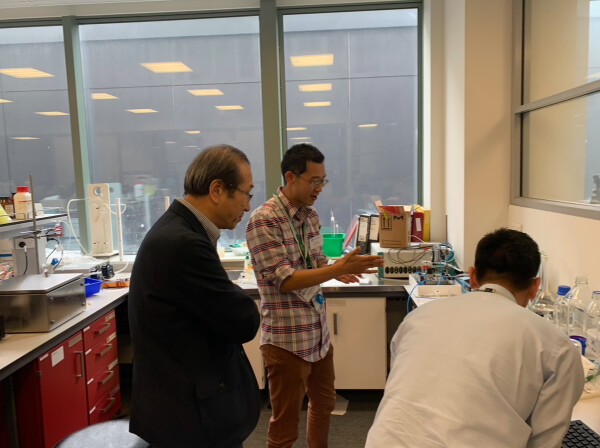
Professor Kitagawa visiting Dr Liu's lab in February 2024
Luke says MOFs are still central to MacDiarmid Institute research.
'We’re currently targeting greenhouse gasses, using MOFs along with other materials to catch CO2 from air and waste streams and design new catalysts that will transform this captured CO2 into green fuels using renewable energy inputs.'
Congratulating the winners, Institute Director Professor Nicola Gaston said that the announcement was all the more special for New Zealand because of the strong links between each of the awardees and the Institute.
‘Shane and Paul have decades-long links with Professors Richard Robson, Susumu Kitagawa, and Omar Yaghi, and all three were in Auckland in 2018 for the MOF Symposium that Shane organised. Plus Professor Kitagawa was here just last year for our regular iCeMS symposium.’
She said that thanks to the work of Professors Kitagawa, Robson and Yaghi, MOFs have been part of the Institute's research for nearly two decades.
‘And we are continuing to research and develop MOFs for environmental remediation, focusing on greenhouse gas capture and conversion.’
To understand how MOFs work, you need look no further than your kitchen sponge.
Professor Shane Telfer Principal Investigator
What are MOFs?
As Professor Olof Ramström, member of the Nobel Committee for Chemistry has said, this year’s chemistry award is ‘a story full of holes, but with enormous capacity to absorb all your attention’.
To understand how MOFs work, Shane says, you need look no further than your kitchen sponge. ‘The pores in your kitchen sponge are the same size as a water droplet. That’s why your sponge works. The pores in metal organic frameworks (MOFs) can be made the same size as gas molecules. That’s how they absorb gasses.’
He says MOFs are mostly free space, like an open porous net, with a metal at the corners and an organic component as the rods or linkers.
‘Rather than being dense and impervious, like a salt crystal for example, MOFs can host molecules in their pores. The allows them to do cool stuff like separate mixtures (by selectively capturing one molecule), catalyse reactions, and deliver payloads by slowly releasing trapped molecules.’
Shane’s start-up company Captivate Technology is based on a patented MOF - MUF-16 – an adsorbent that reduces CAPEX and OPEX costs for carbon dioxide capture from gas streams.
We’re currently targeting greenhouse gasses, using MOFs along with other materials to catch CO2 from air and waste streams and design new catalysts that will transform this captured CO2 into green fuels using renewable energy inputs
Principal Investigator Dr Luke Liu Programme Leader Catalytic Architectures
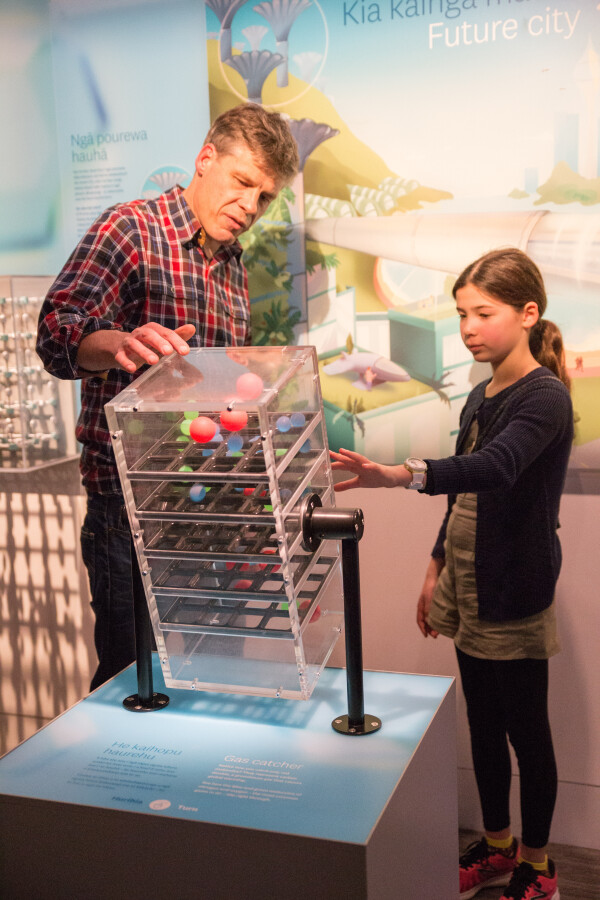
Shane Telfer with the giant MOF at Te Papa
And it turns out there's a giant MOF in Te Papa inside the Te Taiao Nature Exhibition.


© MacDiarmid Institute 2025, All rights reserved
Website by WebWeaver Productions