

News & events
Weaving solutions to tackle waterway pollution
19 March, 2026
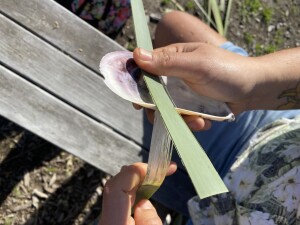
PhD researcher Jaye Barclay traditionally extracts muka (harakeke fibre) using a mussel shell
It’s among the greatest environmental challenges facing Aotearoa: how to clean up waterways degraded by agricultural runoff, industrial waste and legacy pollution. Now, two innovative MacDiarmid Institute-supported projects, grounded in Pūtaiao Māori (Māori science), are delivering sustainable solutions. The two cross-disciplinary initiatives – one centred on a native plant, the other on cutting-edge photochemistry – sit within the Institute’s Pūtaiao Māori Research Programme.
For PhD student Jaye Barclay (they/them, he/him), the research is helping further unlock the potential of harakeke, a taonga that has long bound Māori culture and the natural world.
Jaye’s project aims to use the revered traditional resource as a powerful, sustainable water filter capable of stripping out ions of heavy metals like copper and zinc, using muka – a prepared fibre of harakeke.
'We have been developing and characterising a harakeke membrane for water filtration of particulate contaminants and heavy metals'
Jaye Barclay PhD student
The work, which began at Te Herenga Waka Victoria University of Wellington's (VUW) Robinson Research Institute and has since moved to Te Whare Wānanga o Waitaha University of Canterbury (UC), builds on the team’s earlier success in proving harakeke’s ability to filter bacteria.
“As part of tranche 1 of the project, we have been developing and characterising a harakeke membrane for water filtration of particulate contaminants and heavy metals,” Jaye explains.
The goal: to create a filter that can be grown and produced locally, even in one’s own backyard. The key lies in the muka’s natural makeup: it’s rich in cellulose, a material of growing interest for its adsorbent properties.
“Cellulose has abundant hydroxyl groups, which have high affinity for adsorbing cations like copper and zinc.”
By chemically processing the muka, or by stripping out its wax and lignin, Jaye’s team can produce a purer cellulose suitable for forming a fibrous substrate. This holds the potential to replace the synthetic plastic material that makes up the bulk of many modern filtration membranes with an accessible alternative that’s more cost-efficient and environmentally friendly.
Making the membrane locally, Jaye adds, offers a step towards addressing systemic inequality, particularly in rural areas.
“Producing our own membranes in-house is a meaningful step towards dismantling some of the financial obstacles to water security.”
This would help tremendously in working towards the goal of a low emissions economy, while also improving the environment
Sarah Polson PhD student
Working at the intersection of materials science and Pūtaiao Māori means treating harakeke not just as a raw material, but as a taonga (treasure). This demands a strong commitment to respecting the plant’s mauri (life force) through adherence to tikanga (customs).
“Harvesting in appropriate conditions, performing karakia before harvest, and extracting muka the traditional way using a mussel shell are all ways that we show respect for the plant.”
These practices are learned from kairaranga (weavers) and kaitiaki (guardians). Mātauranga also informs the science itself. Over centuries, Māori have developed dozens of harakeke cultivars with unique properties.
“Consideration of mātauranga for different cultivars is therefore important to select materials that will produce the best-performing technology.”
Another of the project’s strengths is its cross-disciplinary links, bringing together chemical engineering, chemical sciences and pūtaiao Māori.
The team is moving swiftly. Fourth-year student Emma Dobbie has completed preliminary adsorption tests, and new PhD student Caihong Chen will commence work in December to continue investigating methods to improve muka adsorption.
For Jaye, whose journey to reconnect with their Māoritanga (Māori identity) continues, the research has been deeply meaningful.
“The personal connection I have developed with harakeke as a plant is just one benefit that I have received working across materials science and pūtaiao Māori,” Jaye says.
“It’s also helped me contextualise myself as a researcher, define my own research values, and connect to my cultural identity and whakapapa.”
A ‘two-for-the-price-of-one’ solution
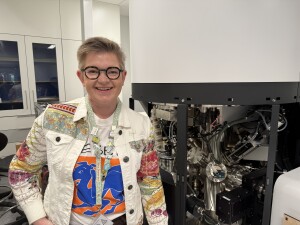
PhD researcher Sarah Polson alongside the X-ray Photoelectron Spectroscopy (XPS) at UC
At UC, PhD researcher Sarah Polson is pursuing another novel way to cleanse water, with an added benefit: renewable energy production. The research targets waterways with elevated organic contaminant levels, often associated with intensive agriculture.
The project’s scientific goals are intrinsically linked to its kaupapa: ensuring the research is relevant and beneficial to the local communities and mana whenua. It involves using organic pollutants as materials in the water that, when broken down by the photocatalysts, promote the production of hydrogen gas from water.
This results in both renewable energy and clean water, or what Sarah calls a “two-for-the-price-of-one” solution. Green hydrogen created from the process, for instance, can be used as a fuel source for transport or energy storage for back-up power.
“This would help tremendously in working towards the goal of a low emissions economy, while also improving the environment,” Sarah says.
Knowing the potential positive impact of her project motivates her to always think ahead, she says.
“Even when there are challenges with synthesis or making model systems to test the photocatalysts, there is always a bigger picture to aspire to.”
Sarah, a former primary school teacher, also draws inspiration from outreach events, which reminded her that science is about “play – and that we should never stop being curious and playful”. That outlook is vital when facing the inevitable technical challenges of a new PhD, such as working with a prototype reactor to measure gas production while ensuring the only quartz reaction vessel doesn’t break.
As with Jaye’s programme, collaboration has been central to the project. Sarah’s supervisor, Associate Professor Vladimir Golovko, who is an Associate Investigator with the MacDiarmid Institute, has helped connect her with others across the Institute, including Te Kunenga ki Pūrehuroa Massey University-based Principal Investigator, Associate Professor Pauline Harris, who will join her supervisory team to provide guidance around the kaupapa.
Sarah is also hoping to work with other researchers.
“No one person can know everything,” she says, “and having the ability to connect, consult, and listen to others’ ideas and perspectives is often the key to moving projects forward”.
Our waterways sustain our lives, and we must work together to find solutions that will restore the health of our rivers and lakes
Professor Pauline Harris Pūtaiao Māori Programme Leader
Pūtaiao Māori Programme Leader Professor Pauline Harris says the team wants to see a truly collective approach to healing Papatūānuku.
“Our waterways sustain our lives, and we must work together to find solutions that will restore the health of our rivers and lakes. It is incredibly important that we support our researchers and students to develop their expertise and build pathways that connect research with iwi Māori.
Nā tō rourou, nā taku rourou, ka ora ai te iwi.
With your food basket and my food basket, the people will thrive.
"This whakataukī reflects the heart of our approach: while we may make progress individually, it is through collaboration that we move from simply surviving to truly thriving.
"Working together strengthens our ability to address pollution and safeguard our environment for future generations.”


© MacDiarmid Institute 2026, All rights reserved
Website by WebWeaver Productions