


News & events
Emulating biology to make simple cells - Annual Report 2025
31 May, 2026
In the hunt for chemical systems that can carry out multiple tasks efficiently, and reconfigure themselves for different purposes, the best inspiration comes from the biological cell.
Built from common elements and consisting mainly of water, our cells perform an impressive array of tasks: they can replicate and repair themselves, make new substances, communicate, and even move - all in a manner that is far more flexible and efficient than any human-made machine. These remarkable capabilities are what researchers are working to capture with potential outcomes of helping pollutants to break down, delivering medicines in a planned sequence, and running chemistry labs in a more environmentally friendly way.
Starting very simply, by exploring drops of one liquid in another liquid - like spheres of oil in a salad dressing - Principal Investigator Associate Professor Catherine Whitby of Te Kunenga ki Pūrehuroa Massey University, is interested in whether she can make multi-compartment droplets with components that can be reconfigured. "Biological systems can make and unmake things. They have some very simple building blocks, but they organise them into a remarkable arrangement of different kinds of materials. So, the overarching idea is, how can we mimic some of that?"
Biological systems can make and unmake things... how can we mimic some of that?
Associate Professor Catherine Whitby
In another lab usually focused on organic electronics, Principal Investigator Professor Jadranka Travas-Sejdic of Waipapa Taumata Rau University of Auckland has expanded her research to investigate how to initiate reactions in different sections of these simplified cells. "In biological cells there are organelles with different functions which respond to stimuli and communicate with each other. We wanted to create artificial cells with distinct components doing different tasks and then use cascade-type reactions to imitate those parts talking to each other."
Jadranka and Catherine are part of the MacDiarmid Institute team working in the Reconfigurable Systems research programme which is focused on progress towards a zero-waste planet. They both emphasise that it is their PhD students who have been doing all the hard work in translating ideas into experiments and making exciting discoveries.
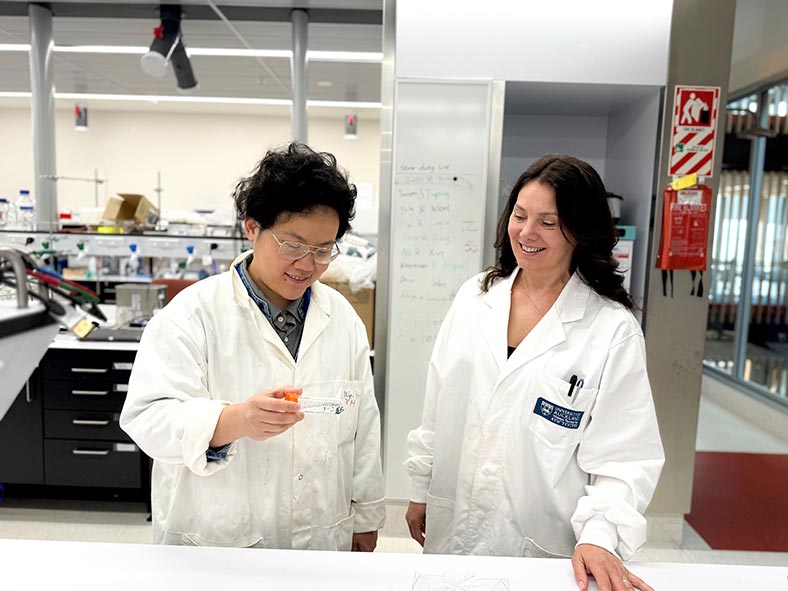
Yang Hui and Jadranka Travas-Sejdic
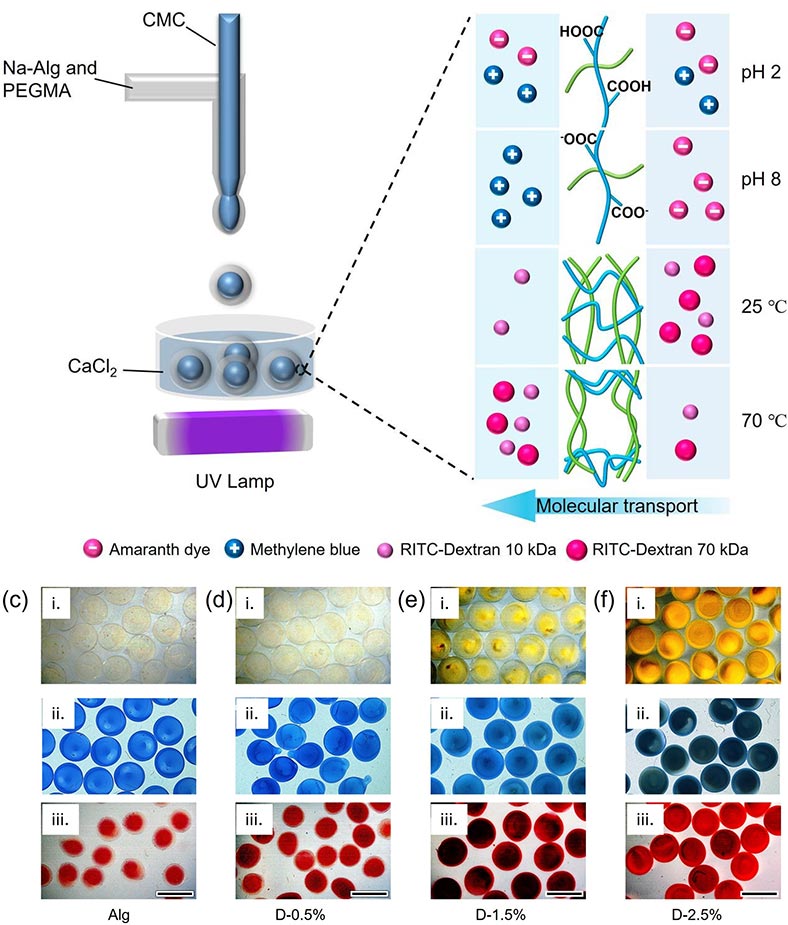
Already, Yang Hui (Jadranka's PhD student) has made artificial cells that can admit different types of molecules through their external membrane just by varying pH and temperature. To make her simple cells, Yang Hui works with hydrogel capsules which are absorbent, jelly-like particles. The ones she's made in the lab have a core of water and a shell of two different types of polymer networks enabling them to respond precisely to more than one environmental stimulus.
"Designing artificial cells is one thing but showing that you can control components within a 'water in water in water' system is quite challenging to achieve," Jadranka says. The researchers have published their novel approach for making these tiny (400 micrometres to three millimetres in size) cell-like beads. The water-based design means the hydrogel capsules are compatible with biological systems and could be used for environmental sensing and monitoring.
Immediately, there are potential applications in green chemistry because, by doing sequential reactions within a single small system, you are saving time and minimising waste.
Professor Jadranka Travas-Sejdic MacDiarmid Institute Principal Investigator
Yang Hui has gone on to work out how to carry out different reactions in each of two different compartments within the hydrogel capsules. She says there's been a lot of troubleshooting, persistence and innovation to get to this point. "But I'm pleased we've been able to control not only the movement of molecules, but also the sequence of reactions within the capsule - I think that's very cool." The work has just been published in the Chemical Engineering Journal and Jadranka says of this progress, "Immediately, there are potential applications in green chemistry because, by doing sequential reactions within a single small system, you are saving time and minimising waste."
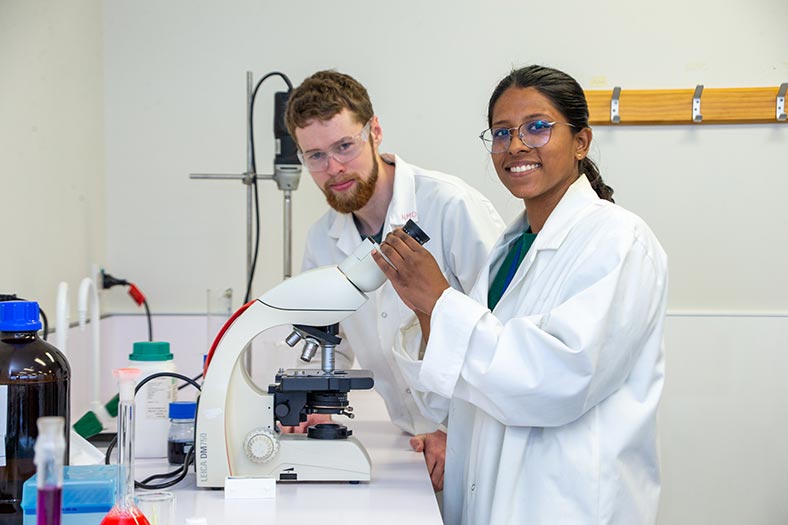
Braydon Nikolaison and Shivangi Chourasia. Photo by David Wiltshire, Massey University.
Meanwhile, Shivangi Chourasia (Catherine's PhD student) is developing reconfigurable emulsions which can change their shape and structure in response to external stimuli such as light or temperature. Emulsions consist of liquids that don't usually mix but, for example, heating can cause two liquids to mix into a single phase, while cooling re-establishes multiple internal droplets. Light irradiation can also cause shape changes through variations in tension at the boundaries between different liquids.
Shivangi's research looks at how adding tiny, solid particles to these emulsions influences the shape and behaviour of droplets. Known as Pickering emulsions when particles are added, these mixtures can be reconfigured under different stimuli - something Shivangi is working out how to control. Currently, she is trialling particles with different properties to see how they influence the stability of the emulsions. Shivangi's emulsions could be used for sensing enzyme activity in healthcare applications, for multi-stage drug delivery or as self-adjusting lenses in phone cameras and microscopes.
And what will the hydrogel capsules be used for? Jadranka and Yang Hui are currently working on the possibility of programmable pollutant remediation. With capsules acting like miniature porous sponges, they could soak up various types of pollutants and degrade them inside different compartments with specially chosen catalysts. Jadranka explains they're currently working at the proof-of-concept level and would ultimately collaborate with engineers to figure out the best uses for these materials.
The PhD students agree that working on cell-like behaviour from different perspectives has enabled them to learn from each other and make their projects more interesting. They are both grateful to be part of the MacDiarmid Institute. As Yang Hui says, "I'm very happy to be a MacDiarmid Institute PhD student because they organise a lot of fantastic activities which have given me opportunities to talk to different people, learn about other projects, and even some history and Māori culture. Shivangi and I have also been able to attend various symposia and a student conference in Melbourne."
Internationally, there is research on artificial cells from various perspectives, but Catherine believes some real novelty has arisen in this project because of the diversity of expertise she and Jadranka have brought together and by being part of an organisation of material scientists who can advise on magnetics or electronics or other fields. "Being part of the MacDiarmid Institute gave us the opportunity to learn about each other's work, identify overlaps, come up with new ideas and slowly build what's turned into a fantastic collaboration." Jadranka agrees, "We cannot emphasise enough the role of the MacDiarmid Institute in this work. It really is an organisation that facilitates the free exchange of ideas and ability to learn from others."
The researchers are adamant that collaboration has been the making of the project, as Catherine describes, "You need a certain critical mass to be able to step out of your comfort zone, head into new areas, and do the kind of exploratory research necessary for making discoveries. The collaboration through the MacDiarmid Institute has given us the capacity and funding to do that. And it brought two fantastic PhD students into the project who have added immense value."
Read next


© MacDiarmid Institute 2026, All rights reserved
Website by WebWeaver Productions