

News & events
International connections, collaborations and celebrations - Annual Report 2025
17 May, 2026
Our international mahi in 2025 deepened long-standing relationships and opened new doors for co-created research grounded in Indigenous values and world-class science.
Building on connections across the Pacific and the Northern Hemisphere, we continued to exchange knowledge on Earth observation, data sovereignty and materials research in ways that centre community priorities and equitable benefit sharing.
During our visit to the United Kingdom, we expanded connections through a series of institutional visits that discussed materials, aerospace and Māori knowledge research and engagement. At St Andrews University, we presented on Māori astronomy and Māori perspectives on aerospace. At Durham University, we connected with researchers on space, sustainability and ethical frameworks.
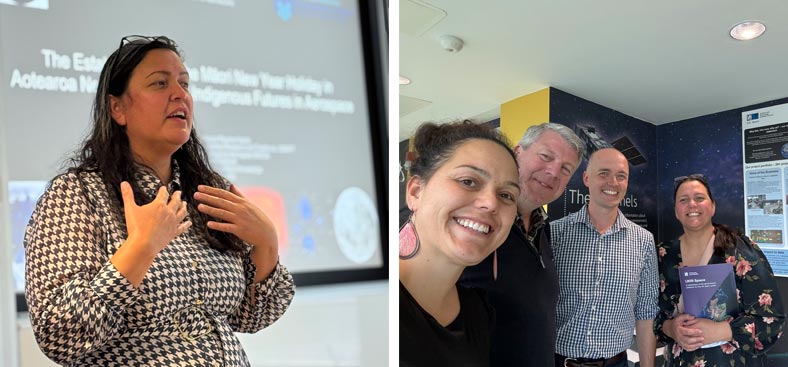
Left: St Andrews University lecture - Pauline Harris sharing Māori astronomy and aerospace research. Right: Exploring advanced instrumentation and collaboration opportunities at RAL. From left: Kirsty Doyle, Andy Shaw, Hugh Mortimer and Pauline Harris.
We also visited the Rutherford Appleton Laboratory (RAL) and were hosted by Dr Hugh Mortimer, Associate Director of the National Laboratories, and Andy Shaw, Director of Assimila. RAL is one of the United Kingdom's leading centres for space science and technology, housing world-class research facilities such as the National Satellite Test Facility and large-scale vacuum chambers used to simulate the conditions of space. We toured several laboratories including the satellite test facilities, viewed the particle accelerator and their rooms for instrument assembly. We were also introduced to one of the Indigenous Australian students interning at RAL Space, which is part of a new partnership RAL has developed with the National Indigenous Space Academy in Australia.
The value of international engagement lies in creating pathways for collaboration, shared opportunities, and enduring partnerships. We look forward to continuing conversations with our new friends and colleagues as we explore and strengthen these relationships into the future.
Mākereti Papakura’s recognition at Oxford was a profoundly significant moment for Whakarewarewa Village - a celebration of Māori excellence, scholarship, and achievement not only for the village, but for Māoridom and all New Zealanders.
Pauline Harris MacDiarmid Institute Deputy Director Māori
These experiences culminated in a moment of deep significance at the University of Oxford, where our delegation, Chair Hēmi Rolleston, Director Professor Nicola Gaston, Deputy Director Māori Professor Pauline Harris and Strategic Manager Māori Kirsty Doyle attended the celebrations of the posthumous conferral of Mākereti Papakura's Master's degree. The posthumous graduation of Mākereti marked the formal recognition of her master's research nearly a century after her passing. More than 300 people attended the ceremony and associated events, including representatives from her home Whakarewarewa Village and iwi Tūhourangi Ngāti Wahiao and Te Arawa, Oxford academics, and dignitaries from Aotearoa New Zealand.
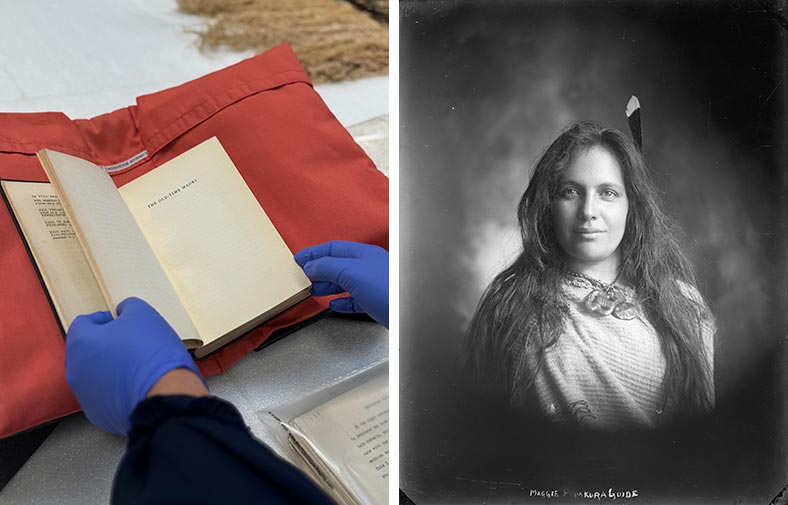
Margaret Pattison Staples-Browne (née Thom, 20 October 1873 – 16 April 1930), more commonly known as Mākereti or Maggie Papakura (right), and her book The Old Time Māori.
Mākereti, also known as Maggie Papakura, was a pioneering cultural guide from Whakarewarewa who became one of the first Māori women to study at the University of Oxford. Her thesis, The Old-Time Māori, was the first ethnographic work authored by a Māori scholar and provided an authentic account of Māori life, customs, and values. The event was both moving and historic, symbolising a moment of recognition for Māori scholarship and the rightful place of Indigenous voices in academia. While in Oxford we also engaged with other academics and communities about the MacDiarmid Institute’s materials, Indigenous knowledge and educational opportunities.
We have partnered with the Whakarewarewa Village Charitable Trust since 2018 in which time we have developed programmes around education and research with them. Participating in the acknowledgement of Mākereti at Oxford was a humbling experience. We look forward to continuing our work with Whakarewarewa Charitable Trust.
Read next


© MacDiarmid Institute 2026, All rights reserved
Website by WebWeaver Productions