

News & events
MOFs - true platform technology - Annual Report 2025
31 May, 2026
It’s not every year that a Nobel Prize aligns with a research area where New Zealand has real expertise, or that resonates so strongly with the work happening in our own labs.
The 2025 Nobel Prize in Chemistry was awarded to international researchers Professors Susumu Kitagawa, Richard Robson and Omar M. Yaghi for the development of metal-organic frameworks (MOFs). The award was not only an incredible celebration of a breakthrough area of chemistry but also shone a light on New Zealand's active and internationally connected role in MOF research.

Nobel laureate Professor Kitagawa in Luke Liu’s lab
MacDiarmid Institute researchers have been part of the global MOF community for years, contributing to advances in materials for clean energy, gas capture and environmental applications, and collaborating with each of the three Nobel laureates.
"What a moment for those of us who love MOFs!" says Principal Investigator Professor Shane Telfer. "It's not every day that they grab the headlines, but they sure have today" Principal Investigator Professor Paul Kruger agrees. "MOFs are a true platform technology. Where you add value is when you combine another material's properties into a MOF to affect change by combining new properties into a porous framework. These can be built upon by many different disciplines. MOFs are phenomenal. We're only limited by our imagination."
What a moment for those of us who love MOFs!
Professor Shane Telfer MacDiarmid Institute Principal Investigator
Principal Investigator and Catalytic Architectures research programme leader Dr Luke Liu said the impact of MOFs had already transformed from basic research to real life. "Several companies have successfully utilised MOFs in various applications, including carbon capture (e.g., Captivate Technology), the semiconductor industry, gas masks capable of breaking down toxic gases, and, most recently, water harvesting from desert air, which is now on the verge of commercialisation."
Luke says MOFs are still central to MacDiarmid Institute research.
"We're currently targeting greenhouse gases, using MOFs along with other materials to catch CO2 from air and waste streams and design new catalysts that will transform this captured CO2 into green fuels using renewable energy inputs."
The announcement was all the more special because of the strong links between each of the awardees and the Institute. Shane and Paul have decades-long links with Professors Richard Robson, Susumu Kitagawa and Omar Yaghi, and all three laureates were in Auckland in 2018 for the MOF Symposium that Shane organised. Plus Professor Kitagawa was here in 2024 for our regular iCeMS symposium.
What are MOFs?
As Professor Olof Ramström, member of the Nobel Committee for Chemistry said, the 2025 Nobel Prize for Chemistry is "a story full of holes, but with enormous capacity to absorb all your attention."
To understand how MOFs work, Shane says, you need look no further than your kitchen sponge. "The pores in your kitchen sponge are the same size as a water droplet. That's why your sponge works. The pores in MOFs can be made the same size as gas molecules. That's how they absorb gases."
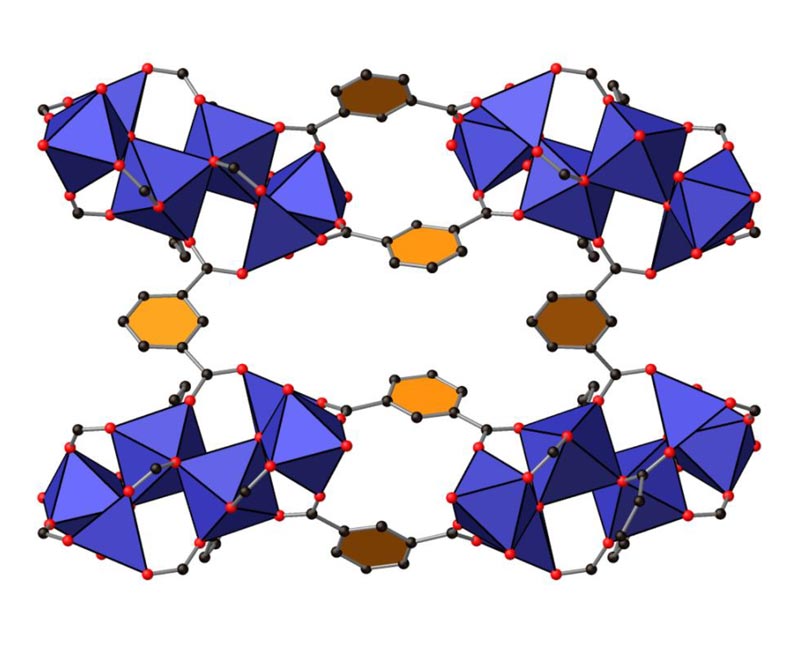
Shane's start-up company Captivate Technology is based on a patented MOF - MUF-16 - an adsorbent that reduces CAPEX and OPEX costs for carbon dioxide capture from gas streams. Captivate Technology is currently targeting greenhouse gases, using MOFs along with other materials to catch CO2 from air and waste streams and design new catalysts that will transform this captured CO2 into green fuels using renewable energy inputs.
Read next
Weaving solutions: how two MacDiarmid Institute projects are helping tackle waterway pollution


© MacDiarmid Institute 2026, All rights reserved
Website by WebWeaver Productions