


News & events
They saw that many electrons, working together, could do something strange, behaving like a single particle showing quantum effects
Associate Professor Natalie Plank Principal Investigator Associate Professor Natalie Plank
Extending her congratulations to the winners of the 2025 Nobel Prize in Physics for their groundbreaking demonstration of quantum mechanical effects at the macroscopic scale, Principal Investigator Associate Professor Natalie Plank said that the winners’ research showed a surprising quantum effect happening in a device they quoted as “big enough to get one’s grubby fingers on”.
‘Professors John Clarke, Michel Devoret, and John Martinis studied a tiny electrical system,’ she said, ‘called a Josephson junction, cooled to very low temperatures and carefully controlled. They saw that many electrons, working together in pairs, could do something strange: they passed through an energy barrier that, according to classical physics, should have stopped them—almost like walking through a wall.’
Natalie said this is known as quantum tunnelling, and that before then, this had only been seen for single particles like electrons or in atoms, not as a collective of many particles acting like a single particle. She added that the scientists also found that the energy levels the electrons could occupy were not continuous but came in discrete steps - another key sign of quantum behaviour.
‘This was the first time both effects were clearly seen in a larger ensemble of particles, showing that quantum rules can apply on the macroscopic scale.’
The prize relates to a key area where our researchers are using novel magnetic semiconductors in the hope of enabling the next generation of quantum computers
Professor Ben Ruck Principal Investigator
Principal Investigator Professor Ben Ruck said the prize related directly to the MacDiarmid Institute’s Future Computing research programme.
‘The prize relates to a key area of focus for the Institute, where our researchers are using novel magnetic semiconductors in the hope of enabling the next generation of quantum computers.’
Ben said that quantum computers exploited the strange properties of quantum mechanics to solve problems which cannot be cracked by any conventional computer.
‘Our Future Computing research involves creating new magnetic versions of exactly the Josephson junctions which formed the basis of the 2025 Nobel Prize in Physics,’ he said.
This work is a really important demonstration of how the quantum properties of individual particles become relevant at the macroscopic scale of materials science, with all its real-world applications
Professor Nicola Gaston Director
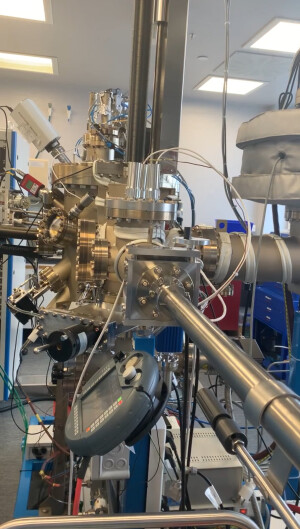
Cleanroom lab at Te Herenga Waka Victoria University of Wellington
Natalie said the quantisation and tunnelling discovered at the time in a device like this, was truly remarkable.
‘This government knows the importance of quantum computing and the future applications that quantum computing will offer, and this fundamental work is the basis of some of the strategies to develop qubits (quantum bits).
She said that the development of superconducting qubits was one of the strategies towards the development of real-world quantum computers such as the superconducting transmon qubits in the IBM supercomputer.
Ben added that while quantum physics can seem other worldly and confusing, this isn’t the first time work in this field has been recognised.
'Similar groundbreaking research has won Nobel Prizes before—in 1933, 1972, 1973, and 1996. technology based on quantum phenomena is having ever greater impacts in our lives As the Nobel committee put it, “There is no advanced technology used today that does not rely on quantum mechanics”,’ he said.


© MacDiarmid Institute 2025, All rights reserved
Website by WebWeaver Productions