

News & events
Optimising networks for brain-like performance - Annual Report 2025
23 May, 2026
Scientists working within a single lab consistently deliver remarkable discoveries. But when they make connections and collaborate with other scientists in other labs, whole new horizons can open up.
For two of our physicists working on nano-electronic devices, it has been a collaboration - first within the MacDiarmid Institute and now with an international lab - that has taken them a step closer to mimicking the human brain.
No computer can yet match the incredible energy-efficiency of human cognitive processing. And with worldwide demand for computing increasing almost exponentially, the more energy-efficient hardware becomes, the better. Our Future Computing research programme is focused on developing materials and technologies fit for a sustainable-energy future.
So how can a computer chip behave more like a brain? How about filling it with a complex network of nanoparticles, putting voltage across it, and seeing what brain-like behaviour emerges? That is, in essence, what Principal Investigator Professor Simon Brown of Te Whare Wānanga o Waitaha University of Canterbury (UC) has been experimenting with. Simon pioneered the understanding of nanoparticle behaviour and is now at the forefront of developments in neuromorphic computing - electronic devices inspired by the structure and function of the brain.
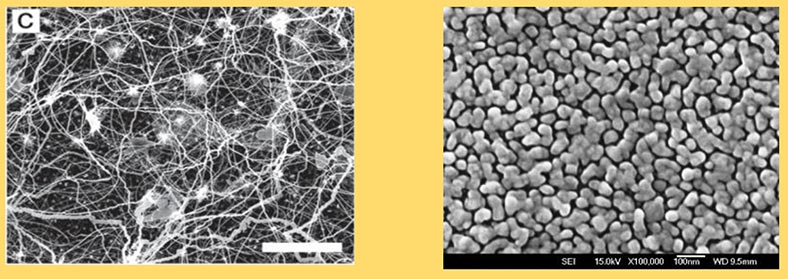
Self-assembled networks of both nanowires (left) and nanoparticles (right) are being investigated for their potential to behave like the network of neurons and synapses in the human brain.
Simon is always opening doors saying, ‘Come on, let’s try everything, let’s work together’. That kind of ethos is at the heart of the MacDiarmid Institute.
Associate Professor Natalie Plank MacDiarmid Institute Principal Investigator
But what if nanowires instead of nanoparticles could behave similarly and contribute to the understanding of the processes at play? That's where Principal Investigator Associate Professor Natalie Plank of Te Herenga Waka Victoria University of Wellington (VUW) comes in. Natalie's been working on nanowire networks for biosensing purposes and now she's trying to encourage brain-like performance out of her devices too. She credits the inclusive research environment for this additional direction. "Simon is always opening doors saying, 'Come on, let's try everything, let's work together'. That kind of ethos is at the heart of the MacDiarmid Institute."
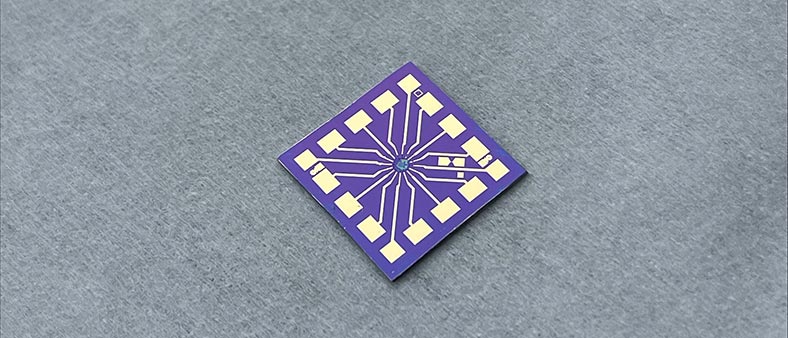
One of the devices made by the researchers (1cm by 1cm in size). A nanowire network sits in the centre (too small to see) and is overlaid by a film of memristive molecules. Gold electrodes extend outwards to contact pads around the edges and these can connect to external measurement devices. The base is a silicon wafer with an insulationg silicon dioxide layer on top.
Both the particle-based and wire-based systems are showing promise for replicating aspects of biological computation. Unlike the tidiness required in standard electronics, Natalie describes her devices as like a messy bowl of spaghetti. Of course, there is careful crafting of such minute structures - each network is a fraction of a millimetre in size - but some chaos is desirable. The jumble of nanowires or particles then creates a self-assembled network consisting of billions of connections or junctions where interesting behaviour can occur. Like the network of neurons in our brains, these neuromorphic devices can be trained to perform analysis or pattern recognition tasks.
We can’t overlook how important it is to meet in person and for students to be exposed to different systems, it opens the mind to what’s possible.
Associate Professor Natalie Plank MacDiarmid Institute Principal Investigator
Progress in the labs at UC and VUW has seen hundreds of neuromorphic devices built. However, the absence of capability for memory has meant that any tasks requiring learning must be performed on a separate device, outside of the nano-network devices. Wanting to enhance their capabilities, Simon built a collaboration with scientists at the Laboratory of Physics and Chemistry of Nano-Objects at the University of Toulouse (UT), the National Institute of Applied Sciences and the National Centre for Scientific Research in France. The French team offered experience in making molecules which exhibit a specific kind of switching behaviour.
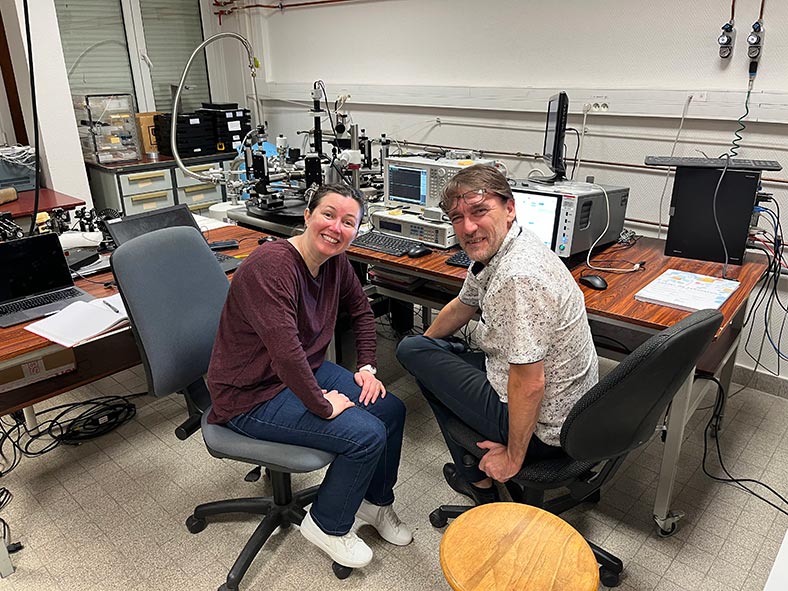
Natalie Plank and Jérémie Grisola working in the lab at the University of Toulouse, France in September 2025
These French-made molecules sounded promising - like adding sauce to Natalie's tangled piles of spaghetti - they might just be the missing ingredient. Thanks to a 2023 Te Apārangi Royal Society Dumont d'Urville Catalyst Grant, Simon, Natalie and their PhD students, Sofie Studholme and Marissa Dierkes, have been working both here and in France with Jérémie Grisolia, Simon Tricard and other French colleagues to experiment with adding memristive (memory + resistor) molecules to nano-networks.
Marissa was incredibly organised. She came to Toulouse with a carefully selected array of samples and showed how adding synaptic molecules was different for each kind of sample.
Professor Simon Brown MacDiarmid Institute Principal Investigator
Memristors are known to have synapse-like properties, but finding molecules that can perform these functions required the expertise and hard work of Simon Tricard and his postdoc Felix Houard. The PhD students also carried out an impressive amount of work. As Simon reflects, "Marissa was incredibly organised. She came to Toulouse with a carefully selected array of samples and showed how adding synaptic molecules was different for each kind of sample." Already, the team have exciting results and plenty more data to work through.
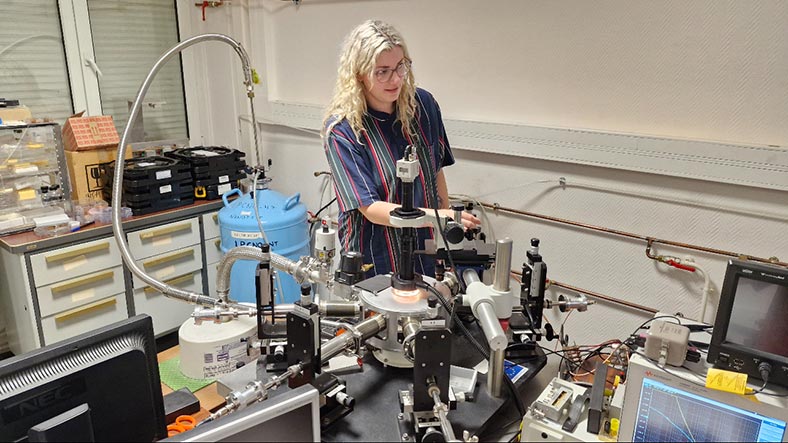
Marissa Dierkes working on her PhD research with the impedance spectroscopy machine at the University of Toulouse, France
As scientists, we can get pretty excited about the details of the physics and chemistry at play in these devices, but actually, a lot of us do want to solve problems which impact the planet and protect ways of life for the future of our children.
Associate Professor Natalie Plank MacDiarmid Institute Principal Investigator
One way to speed up the progress of the mind-bendingly microscopic experimental work is to simulate network behaviour. Simulations can narrow down the abundant combinations of network systems and molecules to explore. The researchers have a paper out in Nanoscale Horizons which describes how placing synapse-like molecules into their neuron-like networks can lead to controlled learning behaviour.
The ability to learn and forget things adds to the richness of the electronic performance of these devices and signals the potential for new types of computation. These findings will direct further experimental work.
By working together, we knew we could do something greater than the sum of our parts.
Associate Professor Natalie Plank MacDiarmid Institute Principal Investigator
The benefits of these chips go beyond energy savings. They don't require extremely expensive equipment; they're small, lightweight, suitable for remote use without internet access and have so many potential applications it's hard to know exactly where they will find their niche in the real world. In Natalie's lab, there's already a design going through patent protection in anticipation of its usefulness. Natalie has her sights on the big picture, "As scientists, we can get pretty excited about the details of the physics and chemistry at play in these devices, but actually, a lot of us do want to solve problems which impact the planet and protect ways of life for the future of our children."
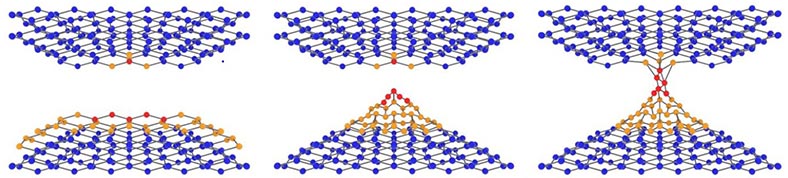
The gaps between nanoparticles (left) can be bridged partially (centre) or fully (right) in response to voltage applied across nano-networks, creating neuron-like spiking events that may be harnessed for computational purposes.
The Catalyst Grant was crucial to the success of this work. Kiwi researchers worked in French labs, and French researchers attended a special session of the International Conference on Advanced Materials and Nanotechnology in which 25 neuromorphic scientists met in Christchurch in February 2025. "We can't overlook how important it is to meet in person and for students to be exposed to different systems, it opens the mind to what's possible" says Natalie. The double meaning of 'network' in this project is not lost on the researchers - as they optimised their collaborative networks, the nano-networks improved in their brain-like capabilities. Natalie believes networking is crucial to the advancement of science, "By working together, we knew we could do something greater than the sum of our parts."
Monaghan, B. L., Heywood, Z. E., Studholme, S. J., Houard, F., Grisolia, J., Tricard, S., & Brown, S. A. (2025). Learning and spiking dynamics in brain-like nanoscale networks. Nanoscale Horizons, 10, 2475-2485.
Read next


© MacDiarmid Institute 2026, All rights reserved
Website by WebWeaver Productions